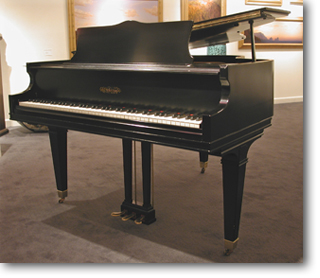
In 1819 he was apprenticed to the piano maker John Osborne, with whom he worked until 1823 when he founded a partnership with the English piano maker James Stewart who had been active with Osborne. They produced 15 pianos the first year at workshops at 20 Common Street and sold their first piano on June 23, 1823 for $275. The firm was organized as Stewart & Chickering, and continued until Stewart returned to England in 1826.
In 1830 Chickering became associated with John Mackay, a merchant, as well as organ and piano maker who had worked with Alpheus Babcock, doing business as Chickering & Co. at 416 Washington Street. In 1837 Chickering and Mackay, along with Mackay's son William H. Mackay, built a new five story factory with warerooms and a small concert hall at 334 Washington Street and a warehouse at Franklin Square. By 1840 the firm was the leading American manufacturer of grand pianos. The firm became known as Jonas Chickering & Co. in 1837. After Mackay’s son, William H. Mackay, joined the firm, the enterprise was known as Chickering & Mackay from 1839 until the death of the elder Mackay in 1841.
John Mackay was lost at sea in February 1841. Chickering mortgaged the factory and bought out John and William H. Mackay's shares in installments. In 1843 the company introduced and patented the one-piece cast-iron frame for the grand piano.
The Washington Street factory burned December 1, 1852 putting over 200 workmen out of work and amounting to loss of $250,000 including all the tools and patterns and a nearly completed prototype for a grand piano. Chickering organized a temporary factory and began construction of a new steam-powered factory at 791 Tremont Street, designed by Edward Payson to Chickering's specifications.
Chickering died on December 8, 1853 before the factory's completion. Over 800 people, including leading piano manufacturers and many of the societies of which Chickering had been a member, marched in his funeral procession. The mayor of Boston ordered the ringing of the city's church bells.
At the time of his death, Chickering's company had built over 12,000 pianos and was producing about 1,500 a year worth $200,000, almost twice the sales of Timothy Gilbert, his largest competitor in Boston. His pianos were exhibited at the London International Exhibition of 1851 and earned a gold medal with special mention for his grand piano which was noted for its brilliancy and power as well as its great solidity. Chickering patented single piece iron frames combined with wrest plank bridges and damper guides in square pianos, and with massive wrest plank terminations in the grand pianos. Chickering & Mackay were assignees of an action patented by Alpheus Babcock, and licensed actions patented by Edwin Brown and George Howe. Chickering pioneered pronounced curved hammer strike lines in squares which permitted larger hammers and he is also credited with encouraging Ichabod Washburn to develop the first music wire produced in the United States.
Chickering, with Henry W. Pickering and Edward Frothingborn, incorporated a charter to erect the Boston Music Hall, paid for by subscription and built in 1852. He served as president of the Handel and Haydn Society and of the Massachusetts Charitable Mechanics Association which he joined in 1829, until his death in 1853.
Chickering married Elizabeth Sumner Harraden November 20, 1823. They had four children: Thomas E. Chickering, C. Frank Chickering, George H. Chickering, and Anna Chickering. Chickering's sons worked as piano makers, and became partners in the company in 1853 forming Chickering and Sons.
Following Jonas Chickering’s death, his eldest son, Thomas E. Chickering (b. Boston, MA, Oct. 22, 1824; d. Boston, MA, Feb. 14, 1871), became president of the firm, a post he held until his death. His second son, Frank (Charles Francis) Chickering (b. Boston, MA Jan. 20, 1827; d. NY, March 23, 1891), settled in NY in 1859 to oversee the firm’s business interests there. Jonas Chickering’s third son, George Harvey Chickering (b. Boston, MA, April 18, 1830; d. Milton, MA, Nov. 17, 1899), served as manager of the Boston factory. The firm received the gold medal of the Paris Universal Exhibition in 1867 and Frank Chickering was awarded the Imperial Cross of the Légion d’honneur. In 1878 P.J. Gildemeester became a member of the firm, and in 1886 he became a partner. During the last years of the century, C.H.W. Foster and George L. Nichols joined the Chickering brothers in running the firm. It became a division of the American Piano Company in 1908. In 1927 the factory was moved to East Rochester, N.Y. |